
Packet capture is the foundation for troubleshooting, cybersecurity investigations, and performance issue resolution. Through packet-level traffic visibility, organizations can quickly identify issues, detect threats, and ensure business continuity.
But packet captures (PCAPs) can also expose sensitive information. Depending on the traffic being monitored, PCAPs may contain personal data, credentials, application information, IP addresses, and other data protected by regulations such as the General Data Protection Regulation (GDPR).
Organizations must understand how to perform packet capture responsibly while maintaining the visibility they need.
Why packet capture raises privacy concerns
Packet capture is most effective when performed with dedicated hardware, which provides the accuracy, reliability, and continuous visibility required for network operations, cybersecurity, and compliance monitoring. Solutions such as network TAPs and packet brokers ensure that traffic is captured without introducing packet loss or impacting production networks.
Profitap IOTA is a packet capture appliance that records network traffic as it traverses the network and stores it in standard PCAPNG format for later analysis. By preserving packet-level data, IOTA enables detailed investigations, threat hunting, troubleshooting, and forensic analysis. However, because packet captures may contain information exchanged between systems and users, they can also include personal data.
Under GDPR, personal data is broadly defined as any information that can directly or indirectly identify an individual. Depending on the environment, captured traffic may include:
- Usernames and email addresses
- IP addresses
- Device identifiers
- Application metadata
- Authentication information
- User activity patterns
Even when packet capture is used solely for legitimate operational purposes, organizations remain responsible for protecting any personal data that is collected, processed, or stored.
What are the GDPR requirements?
GDPR does not prohibit packet capture. However, organizations must ensure that network monitoring activities comply with key principles such as:
Data minimization
Only collect data that is necessary for a specific purpose. Organizations should carefully evaluate what traffic needs to be captured and avoid collecting excessive information.
Purpose limitation
Captured data should only be used for clearly defined objectives, such as network troubleshooting, security monitoring, threat detection, or compliance investigations.
Storage limitation
Traffic data should not be retained longer than necessary. Retention periods should be documented and aligned with organizational policies and regulatory requirements.
Security and confidentiality
Captured traffic often contains sensitive information. Appropriate safeguards must be implemented to prevent unauthorized access, modification, or disclosure.
What’s the role of encryption?
Most modern applications use encrypted protocols such as TLS, which significantly reduces the amount of readable content available in packet captures. As a result, packet capture solutions such as Profitap IOTA can still record and store network traffic, but much of the payload data may remain unreadable without access to the appropriate decryption keys.
Encryption helps protect user privacy and sensitive information, while still allowing network and security teams to analyze metadata, traffic patterns, and protocol behavior. However, some use cases, such as threat investigations, malware analysis, or compliance monitoring, may require access to decrypted traffic.
Organizations should carefully evaluate whether traffic decryption is necessary for their specific use case. When decryption is implemented, appropriate technical and organizational controls should be in place to ensure sensitive data remains protected throughout the monitoring and analysis process.
How to manage data retention responsibly?
One of the most overlooked aspects of packet capture compliance is data retention. We wrote an article packet capture at scale, planning storage and retention.
Keeping packet captures indefinitely increases both compliance risks and storage costs. A data breach involving years of stored packet captures can have significant legal and financial consequences.
Organizations should ensure retention periods align with operational needs rather than storing traffic data simply because storage is available.
Data masking and anonymization
One of the most effective ways to reduce privacy risks while maintaining network visibility is through anonymization.
Anonymization removes or transforms sensitive information so that individuals cannot be identified. This allows organizations to analyze network traffic while minimizing exposure to personal data.
Profitap X2- and X3 series network packet brokers offer traffic and data anonymization capabilities to protect sensitive information before it reaches monitoring, analytics, or security tools. By anonymizing selected traffic elements, teams can continue to investigate performance issues, analyze network behavior, and support cybersecurity operations without unnecessarily exposing personal data.
We wrote an article about this feature, you can read it by following the link: https://insights.profitap.com/traffic-and-data-anonymization-for-monitoring
Common examples include:
- Masking IP addresses
- Obfuscating usernames
- Removing personally identifiable information (PII)
- Replacing sensitive values with anonymized equivalents
When implemented correctly, anonymization helps organizations maintain the operational and security benefits of packet capture while supporting compliance objectives.
Best practices for privacy-conscious packet capture
Organizations can strengthen both security and privacy compliance by combining well-defined policies with controlled packet capture practices. The following recommendations help minimize unnecessary data collection while ensuring that network investigations remain effective.
- Define a clear purpose for every capture session
Create capture sessions only for a specific troubleshooting, security, or compliance objective. Use descriptive session names so packet captures can be easily identified, managed, and removed when they are no longer needed.
- Capture only the traffic you need
Configure Packet Capture Filters to capture only the hosts, protocols, VLANs, or applications relevant to your investigation. Limiting the capture scope reduces the collection of sensitive data while preserving the information needed for effective analysis.

- Use time-range selection to reduce exposure
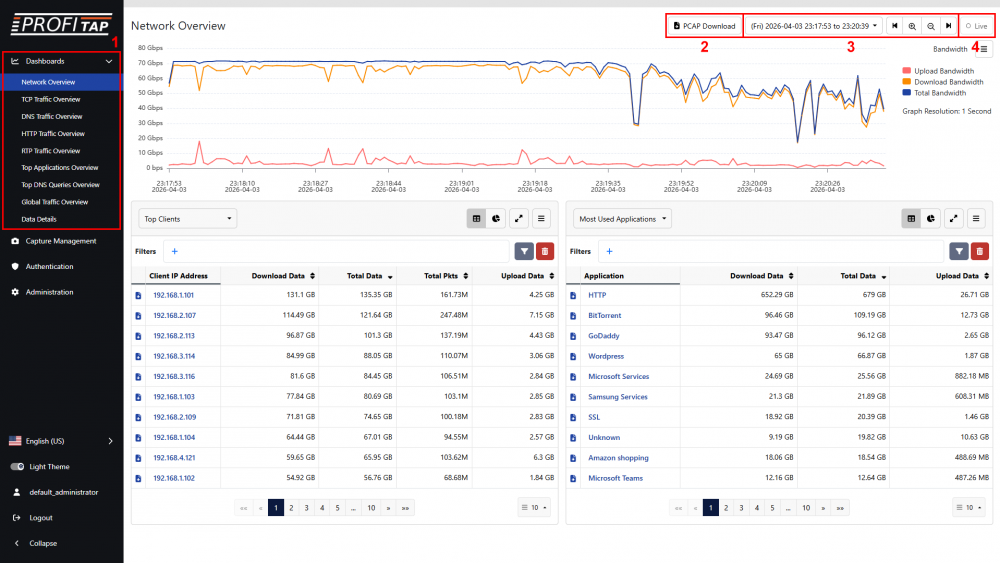
In the Dashboards, narrow the investigation by selecting only the relevant time window or by dragging over the timeline. This minimizes the amount of packet data you need to review or export. (See Dashboard screenshot – [3] Time Range Selector.)
- Apply filters before downloading PCAPs
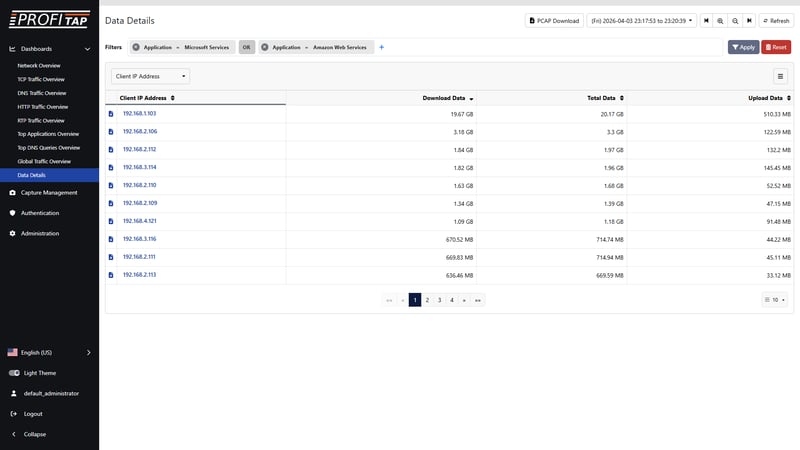
Use the Data Details dashboard to narrow the dataset by IP address, protocol, application, hostname, VLAN, or other metadata before exporting packets. Any active filters are automatically applied to the Download PCAP function, ensuring that only relevant traffic is included in the exported capture.
- Download only the required traffic
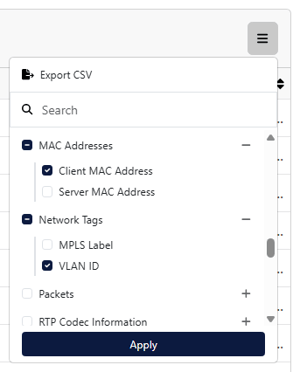
Instead of exporting an entire capture, download only the filtered traffic or a specific table entry. Exporting only the data required for your investigation supports the principle of data minimization and helps reduce unnecessary exposure of sensitive information.
- Control data retention?
Regularly review storage allocation and remove obsolete metadata or packet captures. Define retention periods that align with your organization's security policy and applicable regulations.
- Restrict access to packet data
Ensure only authorized analysts have access to packet captures and exported PCAP files through your organization's role-based access controls and storage permissions.
- Protect exported data
Store downloaded PCAP files in encrypted storage and transfer them only via secure channels when collaborating with other teams is required.
- Maintain accountability
Record who accessed, filtered, or exported packet data as part of your organization's audit process to support forensic investigations and regulatory compliance.
- Review and improve regularly
Periodically evaluate capture filters, retention settings, and monitoring procedures to ensure they continue to meet operational needs while complying with privacy regulations such as GDPR.
Visibility and privacy can coexist
Packet capture remains one of the most powerful sources of network intelligence available to IT and security teams. At the same time, privacy regulations such as GDPR require organizations to handle network data responsibly.
The good news is that visibility and compliance do not have to be mutually exclusive. By implementing careful data governance, strong retention policies, encryption, access controls, and modern anonymization capabilities, organizations can continue to benefit from deep network visibility while reducing privacy risks.
Questions about packet capture and GDPR
Is packet capture GDPR compliant?
Packet capture can be GDPR compliant, but organizations must consider whether the captured network traffic contains personal data and how that data is processed, stored, and accessed. Measures such as data minimization, limited retention periods, access controls, encryption, masking, and anonymization can help reduce privacy risks. Organizations should also have a defined purpose and appropriate legal basis for processing personal data under GDPR.
Does packet capture contain personal data?
Packet captures can contain personal data, depending on the network traffic being captured. This may include IP addresses, usernames, email addresses, device identifiers, application data, authentication information, and other information that can directly or indirectly identify an individual. Even when packet capture is used for troubleshooting or cybersecurity, organizations should treat captured traffic according to their applicable data protection requirements.
How long should packet captures be retained?
Packet captures should be retained as long as necessary for their defined operational, security, or compliance purpose. There is no single retention period that applies to every packet capture environment. Organizations should establish retention policies based on their specific requirements and regularly remove captures that are no longer needed. Shorter, purpose-driven retention periods can also reduce storage requirements and the amount of sensitive information exposed in the event of a security incident.
How does anonymization help protect data in packet captures?
Anonymization helps protect packet data by removing, masking, or transforming information that could identify individuals while preserving useful network information for analysis. For example, IP addresses and other sensitive fields can be anonymized before traffic is forwarded to monitoring, analytics, or security tools. Profitap X2 and X3 Series Network Packet Brokers provide traffic and data anonymization capabilities, allowing organizations to maintain network visibility while reducing unnecessary exposure of sensitive information.
