
OT environments face a growing convergence of IT-related threats and operational safety constraints. For enterprise network security teams evaluating observability architectures, the decision involves more than selecting a monitoring dashboard. Profitap delivers deep OT network observability through passive hardware, packet-level capture, and hardware-enforced security boundaries designed for mission-critical industrial networks.
Let's cover eight evaluation criteria that separate surface-level OT monitoring from the deep network observability required for reliable threat detection and incident response.
OT observability evaluation checklist
| Evaluation criteria | What to look for | Why it matters in OT |
|---|---|---|
| Passive traffic access | Network TAPs with lossless, wire-speed traffic copying | Avoids production impact, latency, and reliance on switch resources |
| Hardware security boundary | Physical data diodes on monitoring ports | Prevents monitoring infrastructure from injecting traffic into production networks |
| Full packet capture | Lossless PCAP with high-precision timestamping | Provides forensic-grade evidence for incident reconstruction and root cause analysis |
| Industrial protocol support | Visibility into protocols such as Modbus TCP and TSN | Gives analysts OT-specific context instead of generic network metadata |
| Industrial deployment options | DIN rail, 24 V power, M12 connectivity, rugged form factors | Enables reliable deployment on plant floors and other demanding environments |
| Traffic aggregation and filtering | Network Packet Brokers with filtering, replication, and aggregation | Prevents monitoring tools from being overloaded with irrelevant traffic |
| Distributed site visibility | Local capture, storage, and remote analysis | Reduces WAN bandwidth requirements and enables remote troubleshooting |
| Security and compliance support | Packet-level evidence, audit trails, and forensic readiness | Supports visibility and incident-response requirements across OT security frameworks |
Key takeaways: OT network observability
- Passive traffic access is essential because it ensures OT observability does not disrupt production systems or add latency.
- Full packet capture delivers the ground truth data that metadata-only analysis cannot match for forensic investigations.
- Hardware-enforced security boundaries, such as data diodes, must prevent any data injection back into production OT links.
- Profitap enables lossless, high-fidelity OT network observability across industrial, edge, and data center environments with passive hardware.
- Scalable observability architectures support distributed deployments ranging from single plant floors to multi-site industrial operations globally.
Evaluating deep observability for OT networks
1. Passive traffic access without operational disruption
OT environments operate under strict availability requirements. Any observability solution deployed in these networks must access traffic passively, without introducing a point of failure or adding latency to time-sensitive protocols such as Modbus, PROFINET, or EtherNet/IP.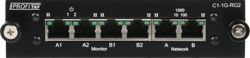
Deploy network TAPs that create bit-for-bit copies of live traffic at wire speed. This eliminates reliance on switch-based mirroring, which risks packet loss under congestion and cannot guarantee timing accuracy. Passive TAPs also operate independently of switch CPU load, ensuring consistent data quality regardless of network utilization levels.
2. Hardware-Enforced security boundaries
In high-assurance OT environments (ICS/SCADA, energy grids, water treatment), any device connected to a production link for observability must be capable of injecting packets back into the network. This requirement is non-negotiable for critical infrastructure protection.
Profitap's industrial TAPs feature integrated data diodes that physically prevent any commands or signaling from flowing back toward the production network. In sensitive environments, even a brief unintended transmission is unacceptable. This hardware-enforced boundary ensures your monitoring chain cannot become an attack vector.
3. Full packet capture for forensic analysis
Metadata and flow-based approaches give you high-level traffic patterns, but they cannot reconstruct full sessions, decode proprietary industrial protocols, or support detailed forensic investigations after a security incident. For OT networks where safety and compliance are paramount, incomplete data means incomplete conclusions.
Evaluate whether a solution captures every packet with nanosecond-precision timestamping. This level of fidelity is the ground truth you need for root cause analysis, compliance evidence, and incident reconstruction. Lossless capture ensures that no anomalous packet goes unrecorded during critical security events in your OT environment.
4. Industrial protocol support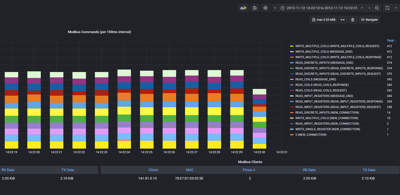
IT-centric observability tools often lack support for OT-specific protocols. Your evaluation should confirm native parsing capabilities for OT protocols.
The Profitap IOTA platform supports Modbus TCP and TSN traffic with low-jitter capture, enabling real-time dashboards that present operational context alongside packet-level network metrics. This means your security analysts see actionable, protocol-aware data rather than undifferentiated raw traffic streams.
5. Deployment flexibility across harsh environments
OT sites range from climate-controlled server rooms to plant floors, where extreme temperatures, vibration, and electromagnetic interference are present. Your observability infrastructure needs to match the physical environment where it operates, not just the logical network topology above it.
Evaluate whether devices support 24V, DIN rail mounting, rugged M12 connectors, and compact form factors designed for demanding industrial settings. Profitap industrial network solutions are purpose-built for these conditions, ensuring fail-safe operation at the edge of your OT network where environmental constraints are most severe.
6. Scalable traffic management and aggregation
As OT networks grow, the volume of traffic routed to security and analysis tools increases proportionally. Without proper aggregation and filtering at the access layer, those tools become overloaded, and alert fidelity degrades across the entire monitoring chain.
Network Packet Brokers aggregate, replicate, and filter traffic from multiple TAP points before delivering it to your security and performance tools. This optimizes tool utilization and ensures that each device in your monitoring chain receives only the data relevant to its function, significantly reducing noise.
7. Remote and distributed site coverage
Many OT deployments span remote substations, offshore platforms, or geographically dispersed manufacturing plants. Sending raw packet data from each site to a central SOC is often cost-prohibitive due to bandwidth constraints and high egress fees on WAN links.
IOTA enables local capture, storage, and analysis at remote sites, eliminating the need to backhaul massive PCAP files across expensive WAN connections. Your security teams can perform traffic capture and analysis remotely, reducing mean time to resolution without costly on-site travel to distributed locations.
8. Alignment with security frameworks and compliance
Regulatory frameworks such as NIST CSF 2.0, IEC 62443, NERC CIP, and NIS2 require documented network visibility and incident response capabilities in OT environments. According to the SANS 2025 State of ICS/OT Security Report, regulated sites experience roughly 50% fewer financial and safety impacts from incidents, demonstrating how documented observability reduces operational risk.
All Profitap solutions align with network security mandates by delivering lossless, tamper-evident traffic access that supports audit trails, forensic readiness, and compliance documentation across critical infrastructure sectors, including energy, manufacturing, and water utilities.
How to select the right OT observability architecture
Selecting an OT observability solution requires balancing operational safety with detection depth. Prioritize solutions that deploy passively, enforce physical security boundaries, and deliver packet-level fidelity for both real-time detection and historical forensic analysis.
Profitap gives you a complete OT network observability architecture, from passive traffic access and aggregation to high-fidelity capture and remote analysis. The result: full network visibility without operational compromise.
Start by mapping your critical OT segments, identifying blind spots, and deploying TAPs at those points. Scale your monitoring chain with Packet Brokers and distributed IOTA devices to cover your entire critical infrastructure footprint.
FAQs about OT Network Observability
What is OT network observability?
OT network observability is the ability to capture, inspect, and analyze all traffic flowing through operational technology networks at packet level. Deep observability gives you forensic-grade data for threat detection and incident response in industrial environments.
Why are passive TAPs preferred over port mirroring in OT?
Passive TAPs create a lossless copy of traffic without introducing a point of failure or adding latency. Port mirroring relies on switch CPU resources, risks dropping packets under load, and cannot guarantee timing accuracy for time-sensitive OT protocols.
How does a data diode protect OT networks during monitoring?
A hardware data diode physically prevents any data, commands, or signaling from flowing back from the monitoring port to the production network. This ensures observability tools cannot become an attack vector in ICS/SCADA environments.
Can OT observability solutions handle distributed industrial sites?
Yes. Profitap IOTA captures and analyzes traffic locally at remote sites, eliminating the need to transfer massive PCAP files to a central location. This reduces bandwidth costs and accelerates incident response for geographically dispersed operations.
What compliance frameworks require OT network visibility?
NIST CSF 2.0, IEC 62443, NERC CIP, and the EU NIS2 Directive require organizations to maintain documented network visibility and detection capabilities in OT environments. Packet-level observability supports audit-evidence and forensic-readiness mandates.
How does Profitap support OT network observability?
Profitap delivers end-to-end OT observability through passive industrial TAPs, Network Packet Brokers, and the IOTA capture platform. These solutions ensure lossless traffic access, hardware-enforced security, and remote analysis capabilities purpose-built for critical infrastructure networks.
