
What they are, where they fit, and how to monitor them safely
As data centers move from 40G and 100G to 400G, many operators want to reuse their existing duplex multimode fiber infrastructure rather than replace it with parallel MPO/MTP cabling. This is where BiDi, or bidirectional multimodal optics, becomes important.
Two terms that often appear in this context are 100GBASE-SR-BiDi and 100GBASE-SR1.2.
They sound similar, and both are used for short-reach 100G transmission over duplex multimode fiber, but they are not the same thing. Let’s explore their differences.
What is 100GBASE-SR-BiDi?
100GBASE-SR-BiDi, often also seen as 100GBASE-SRBD, generally refers to the earlier generation of 100G bidirectional short-reach optics. A common example is the dual-rate 40G/100G BiDi transceiver family used to upgrade existing duplex LC multimode fiber links.
The main benefit is simple: operators can move to 100G without replacing existing two-fiber LC cabling. Instead of using separate fibers for transmit and receive in the traditional way, BiDi optics use different wavelengths in opposite directions on the same fiber pair. This allows full-duplex communication over the same duplex multimode fiber that may previously have supported 10G or 40G.
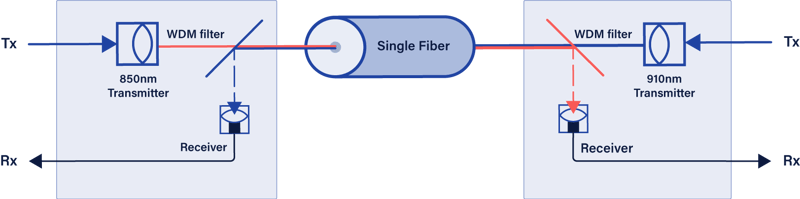
Diagram of full-duplex communication over a single fiber using two different wavelengths.
These optics are especially useful in brownfield data centers where pulling new fiber is expensive, disruptive, or physically difficult. They are commonly used for short-reach switch-to-switch, leaf-spine, and aggregation links within a data center.
However, 100GBASE-SR-BiDi should be treated as a specific optic family rather than a generic universal standard. Compatibility depends on the exact transceiver type, vendor support, wavelength plan, and switch platform.
What is 100GBASE-SR1.2?
100GBASE-SR1.2 is a newer type of 100G bidirectional multimode optic. Like SR-BiDi, it uses duplex LC multimode fiber and allows 100G transmission over two fiber strands. The key difference is its role in 100G-to-400G migration.
100GBASE-SR1.2 is designed to align with 400GBASE-SR4.2 architectures. In practical terms, this means it can be used in environments where a 400G SR4.2 port is broken out into four 100G SR1.2 links. This makes it ideal for new 100G deployments where 400G migration is already on the roadmap.
In most cases, SR1.2 BiDi optics are not interoperable with earlier SRBD optics. Both ends of the link must use compatible transceivers.
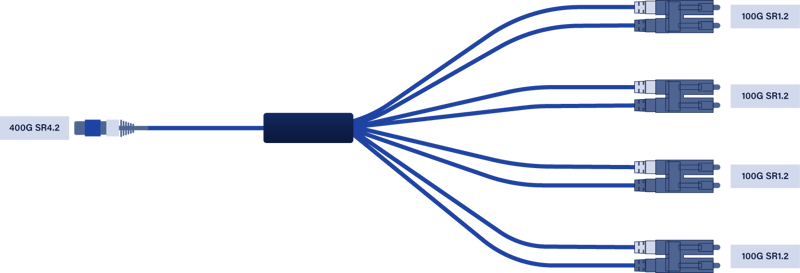
Diagram of a 400GBASE-SR4.2 breakout cable in four times 100GBASE-SR1.2 links.
Key differences
The practical differences can be summarized as follows:
|
Feature |
100GBASE-SR-BiDi / SRBD |
100GBASE-SR1.2 |
|
Typical use case |
Upgrade existing 40G/100G duplex MMF links |
New 100G deployments with 400G breakout migration |
|
Fiber type |
Duplex multimode fiber |
Duplex multimode fiber |
|
Connector |
LC duplex |
LC duplex |
|
Speed support |
Often 40G/100G dual-rate, depending on optic |
100G |
|
400G migration |
Not intended for 400G SR4.2 breakout |
Designed to align with 400G SR4.2 breakout |
|
Interoperability |
Must match the same SRBD optic family |
Must match SR1.2/SR4.2-compatible optics |
|
Monitoring complexity |
Requires BiDi-aware monitoring |
Requires BiDi-aware monitoring |
The most common mistake is assuming that any 100G BiDi optic will work with any other 100G BiDi optic. That isn't the case. The wavelength plan, modulation, lane structure, and vendor/platform support all matter.
When to use
SR-BiDi / SRBD is often about preserving existing infrastructure.
Use 100GBASE-SR-BiDi or SRBD when upgrading an existing duplex multimode fiber environment to 100G while preserving the installed fiber plant. This is especially relevant when the network already contains 40G/100G SRBD optics and the switch platforms officially support them.
SR1.2 BiDi is primarily about 100G deployment, with future alignment to 400G.
Use 100GBASE-SR1.2 BiDi when building or refreshing a data center network that needs 100G now but is expected to support 400G later. SR1.2 provides a cleaner migration path to 400G SR4.2 breakout designs, where a single 400G port can connect to multiple 100G links.
Why monitoring BiDi links is different
Monitoring a normal duplex optical link is relatively straightforward. One fiber carries traffic in one direction, and the second fiber carries traffic in the opposite direction. A passive optical TAP can split the light from each fiber and provide a copy of each direction to a monitoring tool.
BiDi links are different. In a BiDi system, each fiber can carry traffic in both directions using different wavelengths. This means the traffic direction is not separated simply by physical fiber. It is separated by wavelength. As a result, a standard passive duplex multimode TAP will not properly separate bidirectional traffic, leading to incomplete or degraded monitoring visibility.
For packet visibility, intrusion detection, network detection and response, lawful intercept, performance analysis, or forensic capture, the monitoring infrastructure must be designed specifically for BiDi links.

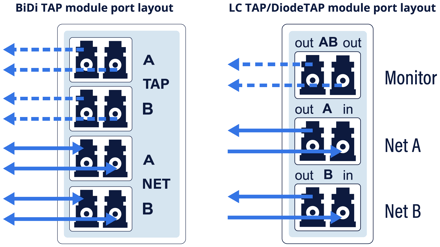
Profitap MOD-TAP with 16 x F1B-MOD BiDi Fiber TAP modules.
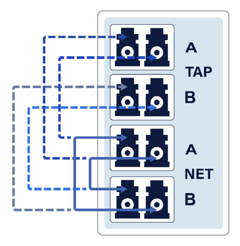 A dedicated BiDi TAP, such as Profitap’s F1B-MOD modular BiDi TAP module or the F1R-BD and F3R-BD BiDi TAPs, can be used for this purpose. These TAPs are designed for bidirectional 40/100G monitoring environments and can support both 100GBASE-SR-BiDi and 100GBASE-SR1.2 deployments when matched to the correct fiber type, split ratio, wavelength plan, and optical budget.
Profitap F1B-MOD BiDi TAP module internal port connectivity.
Using a dedicated TAP provides a fail-safe, lossless, and entirely passive physical-layer visibility point, ensuring total data integrity. In contrast, SPAN ports are switch-dependent features that often lack the necessary precision and reliability required for demanding cybersecurity and high-speed packet analysis scenarios.
Monitoring options
There are two broad types of monitoring to consider.
1. Link health monitoring
The first layer is transceiver and interface health monitoring. This is done through the switch, router, or network operating system using DOM/DDM telemetry and interface counters.
Important values include:
- Transmit optical power
- Receive optical power
- Module temperature
- Module voltage
- Laser bias current
- Link flaps
- CRC or FCS errors
- Symbol errors
- FEC corrected codewords
- FEC uncorrected codewords
- Pre-FEC BER, where available
For 100G links, FEC counters are particularly important. A link may remain operational while the error rate increases. Rising corrected FEC counts can be an early warning sign of dirty connectors, marginal optics, excessive loss, fiber degradation, or incompatible components.
2. Packet-level monitoring
The second layer is packet visibility. This is required when tools need to inspect the actual network traffic.
For BiDi networks, packet monitoring should not be treated as a simple fiber-splitting exercise. The monitoring solution must understand the optical behavior of the link. Depending on the architecture, this may require:
- BiDi Fiber TAPs
- Network Packet Brokers
- Purpose-built RX-only monitoring transceivers
A TAP such as Profitap’s F1B-MOD or F1R-BD/F3R-BD provides a purpose-built monitoring point for BiDi links. It forwards a copy of the traffic to the monitoring tools while keeping the production link independent from the monitoring infrastructure.
SPAN or mirror ports can be useful for basic troubleshooting, but they are not a good substitute for a proper TAP-based monitoring architecture. SPAN traffic can be dropped under congestion, may not preserve timing accurately, may be affected by switch configuration, and does not expose physical-layer problems as effectively as direct optical monitoring.
For high-speed BiDi networks, a dedicated TAP is the preferred option because it provides more reliable, continuous, and independent packet visibility.
The need for RX-only transceivers in monitoring networks
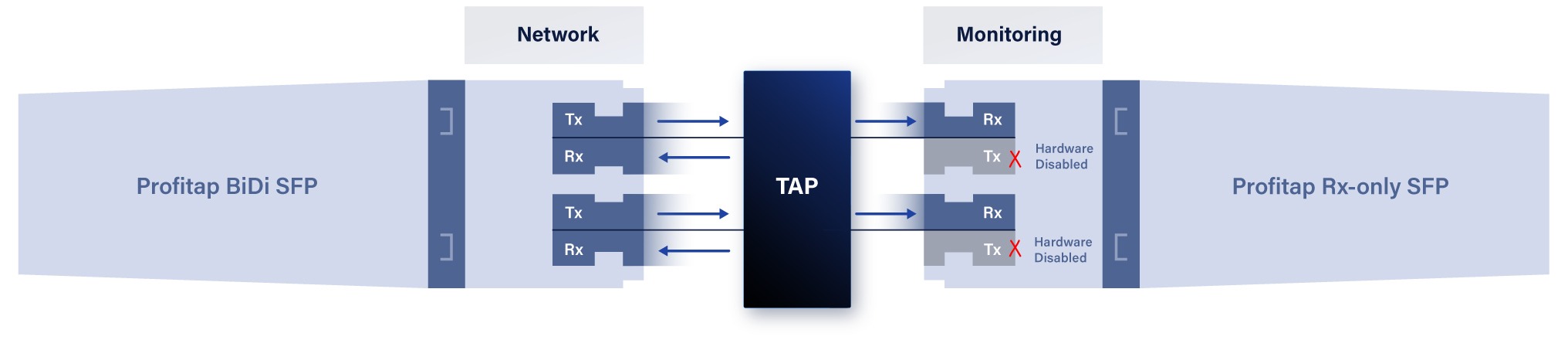
For monitoring applications, there is a critical security requirement that is sometimes overlooked: the monitoring interface should be physically incapable of transmitting traffic toward the production network.
This is where RX-only transceivers become important. In a monitoring architecture, the goal is to observe traffic, not participate in the network. Any device connected to a production link for monitoring should not be able to inject packets, send control-plane traffic, respond to frames, or accidentally transmit during startup.
A standard transceiver, even if configured as “receive only” in software, may still have an active transmit path.
For example, TX signals could occur during:
- Device boot
- Interface initialization
- Firmware loading
- Driver reset
- Misconfiguration
- Link negotiation
- Fault recovery
- Software upgrade
- Human error
- Compromised monitoring equipment
In sensitive environments, even a brief unintended transmission back toward the production network is unacceptable. Any potential risk of disturbing the live link, triggering security alerts, interfering with normal network behavior, or enabling deliberate traffic injection must be avoided.
For this reason, monitoring ports should use RX-only transceivers with the hardware TX components disabled entirely, such as Profitap’s RX-only BiDi transceivers. These are designed for one-way traffic capture, with the transmit function disabled at the hardware level rather than merely blocked by software configuration.
Profitap RX-only transceivers
Profitap RX-only transceivers are used for monitoring infrastructure in environments such as:
- Financial networks
- Government networks
- Defense and intelligence environments
- Critical infrastructure
- Telecom cores
- Data center interconnects
- Cloud and colocation environments
- Security operations centers
- Lawful intercept systems
- High-assurance packet capture deployments
In these environments, the monitoring network must be trusted not only to capture traffic accurately, but also to avoid becoming an injection point.
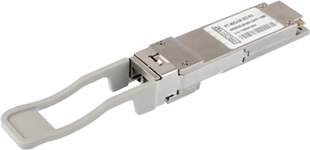
PT-40G-SR-BD-RX
PT-40G-SR-BD-RX is a QSFP+ receive-only transceiver designed for environments where 40G monitoring is still widely deployed.
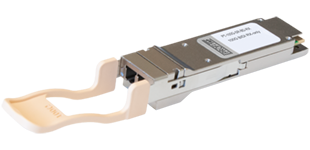
PT-100G-SR-BD-RX
PT-100G-SR-BD-RX extends the RX-only concept to modern 100G monitoring deployments using QSFP28 interfaces.
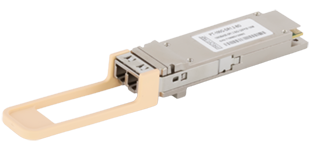
PT-100G-SR1.2-BD-RX
PT-100G-SR1.2-BD-RX provides support for the newer 100G SR1.2 and 400G SR4.2 standards.
Recommendations for monitoring 100G BiDi
- Confirm the exact optic family in use. SRBD and SR1.2 should not be mixed unless interoperability is explicitly supported.
- Validate the optical budget. Short-reach multimode BiDi links often have a limited loss margin. Adding passive splitters, extra patching, or inappropriate optics can push the link outside specification. Read our article about optical budget & split ratios in fiber here: https://insights.profitap.com/optical-budget-split-ratios-in-fiber-network-monitoring
- Use BiDi-aware TAP infrastructure. For these links, a TAP such as Profitap’s F1B-MOD or F1R-BD/F3R-BD can be used to monitor both 100GBASE-SR-BiDi and 100GBASE-SR1.2 environments, provided the TAP is correctly selected for the link type, wavelength range, fiber type, and required split ratio.
- Use RX-only monitoring transceivers wherever monitoring equipment connects to captured traffic paths. Profitap’s RX-only BiDi transceivers are designed specifically for this type of passive visibility use case, with TX disabled in hardware to prevent accidental or malicious signal injection.
- Avoid relying on SPAN for critical 100G monitoring. SPAN may be acceptable for ad hoc troubleshooting, but TAP-based visibility is the better architecture for continuous monitoring.
- Monitor both physical-layer and packet-layer indicators. Optical power and FEC counters tell you whether the link is healthy; packet capture tells you what the network is doing.
Conclusion
Both 100GBASE-SR-BiDi and 100GBASE-SR1.2 BiDi solve an important problem: delivering 100G over duplex multimode fiber. However, they serve different design goals.
What is the difference between 100GBASE-SR-BiDi and 100GBASE-SR1.2 BiDi?
100GBASE-SR-BiDi, or SRBD, is often used to preserve existing duplex multimode cabling and to support practical upgrades from earlier short-reach environments.
100GBASE-SR1.2 BiDi is better aligned with newer architectures and future 400G SR4.2 breakout designs.
For network monitoring, the key takeaway is that BiDi links require BiDi-aware visibility solutions. The optical design is different, the directionality is wavelength-based, and standard passive monitoring assumptions may not apply.
A dedicated BiDi TAP, such as Profitap’s F1B-MOD, F1R-BD, or F3R-BD, is better suited than SPAN for reliable packet-level visibility. It provides a physical-layer monitoring point that is independent of switch configuration and less exposed to congestion-related packet loss than mirrored traffic.
Just as importantly, monitoring infrastructure must be safe. In high-assurance environments, monitoring devices should use RX-only transceivers with TX disabled in hardware, such as Profitap’s RX-only BiDi transceivers. This prevents accidental or malicious traffic injection and ensures that monitoring remains truly passive.
